We use cookies

We use cookies to analyze traffic, remember preferences and improve the usability of the website. To give your consent, click on the "I Agree" button.

Settings I agree

You can refuse consent at any time.

Skip to content Skip to menu
Free Metal Separation Test for Waste in 3 Days | SOLLAU

How much metal is your waste losing? Send a sample — know in three days

Iron makes up roughly 6.6% of municipal waste by weight. At a thousand tonnes a day, that's about 66 tonnes of sellable iron — either earning you money or wrecking your shredders and press dies. We'll test your material for free and tell you exactly what a separator can pull out of it.

within 3 daysyour material test result, free
with every unitmeasurement report and gauss chart
up to 10 yearswarranty on the magnetic core
within 2 daysguaranteed service response

Where metal in your waste costs you money

Four operations, four different problems — and every time the same cause: metal that has no place in the stream, or metal that ends up in a landfill instead of a buyer.

Sorting lines for municipal and separated waste

A piece of fitting or a motor part stops the shredder — and the whole line with it. At the same time, iron that gets through lowers the buyback price of the sorted fraction — even though it would have value on its own.
RDF and SRF producers

Metal wrecks press dies, and the cement-plant buyer keeps a close eye on the metal content of the fuel. The material layer on the wide belt is deep, so an ordinary magnet can't reach into it.

Incineration and WtE plants — feed and bottom ash

Both ferrous and non-ferrous metals worth selling remain in the bottom ash. The catch: around 80% of the non-ferrous metals are under 20 mm — and a coarse separator lets them through.

Municipal waste landfills

What gets buried never gets sorted again. Every tonne of iron that passes through unseparated is both lost revenue and needlessly paid disposal cost.

What solves it

Five separators cover the vast majority of operations in waste management. For each one we state where, by comparison with the competition, we're the only ones, or the best.

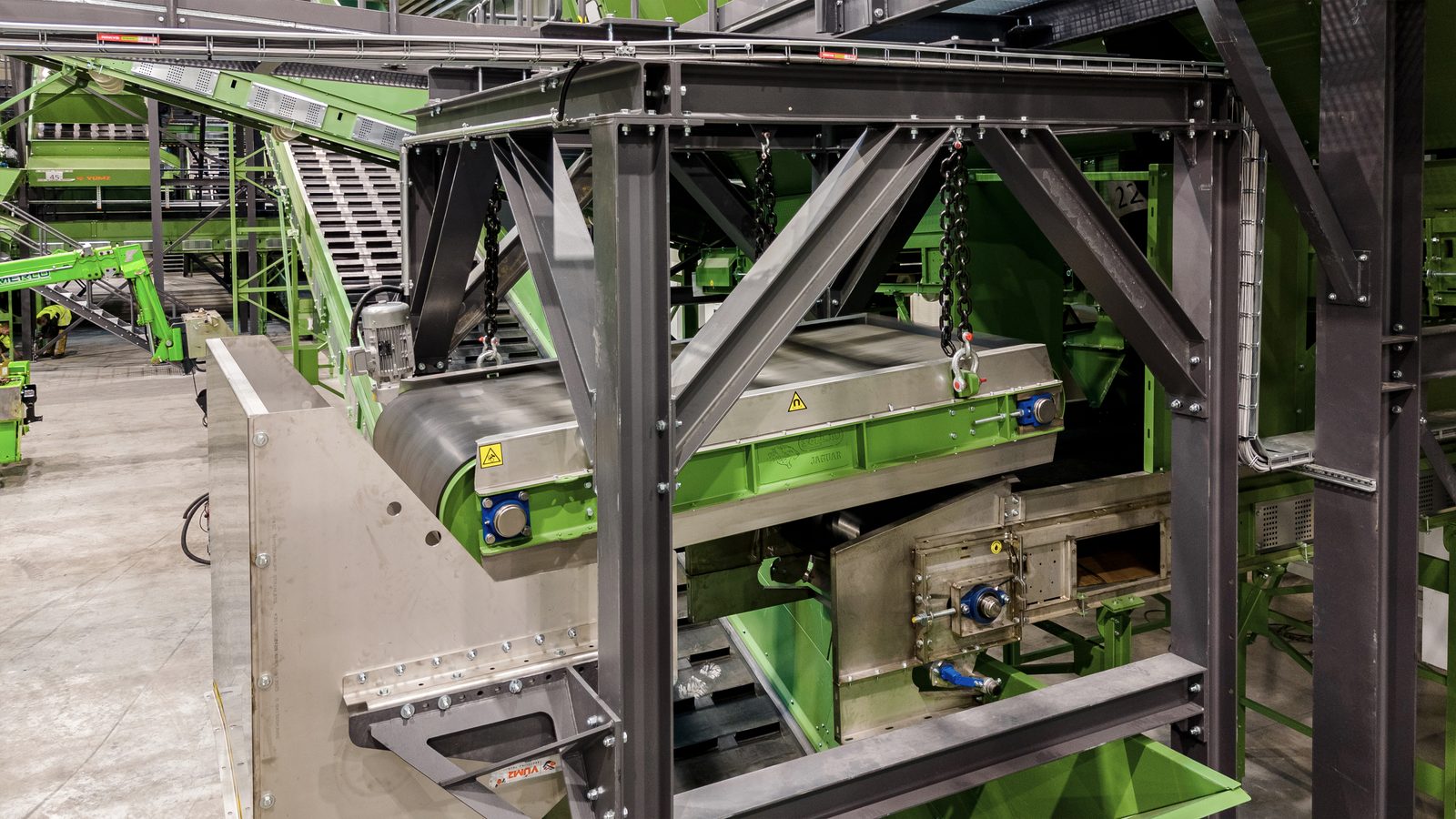
Self-cleaning overband magnetic separator DND-AC above a conveyor belt
Above the conveyor belt

Self-cleaning overband magnetic separator DND-AC

The only ones on the market who publish our field-measurement methodology: gauss charts every 50 mm up to 400 mm, and a test against 13 reference standards.

Captures iron 0.5–300 mm from a height of up to 500 mm (ferrite) on belts up to 2,000 mm wide. Twelve model ranges, cross and in-line installation. The BEAST range handles a deep RDF/SRF layer without an electromagnet and its continuous power draw.

Details on DND-AC →
Magnetic drum MB for separating iron from bulk waste
Into the chute after the shredder

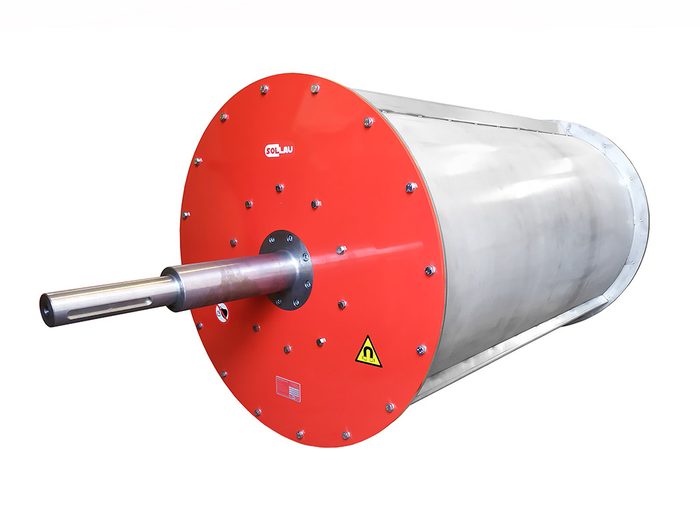
Magnetic drum MB

The only ones who publish induction on both the core and the shell for the whole range — ferrite 1,600–2,800 G on the core, neodymium 5,200–6,000 G.

Diameters from 154 mm for post-sorting lines up to large operations, capacity 15–220 m³/h, capture from 0.5 mm. Optional manganese shell with covers you can replace yourself without removing the drum. 5-year warranty.

Details on MB →
Eddy current separator ECS for separating non-ferrous metals
Aluminium, copper and brass

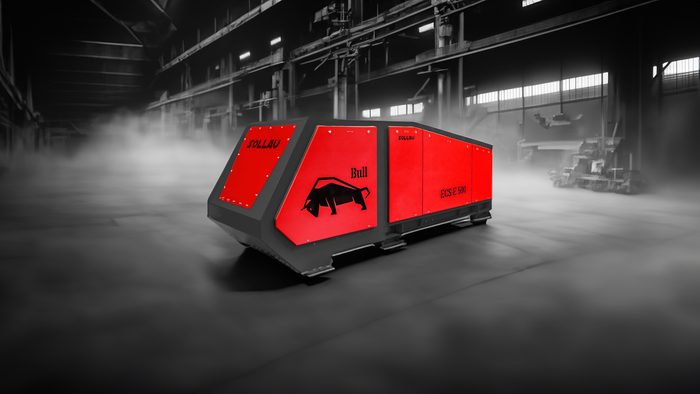
Non-ferrous metal separator ECS

The only ones offering rotors from 4 to 40 poles — from coarse waste to a fine fraction from 0.5 mm.

For bottom ash from WtE plants we recommend the eccentric BULL or BUFFALO models: most of the non-ferrous metals there are under 20 mm, and a four-pole machine lets them through. Belt change in under 6 minutes. BULL and BUFFALO come with a 3-year warranty including three inspections.

Details on ECS →
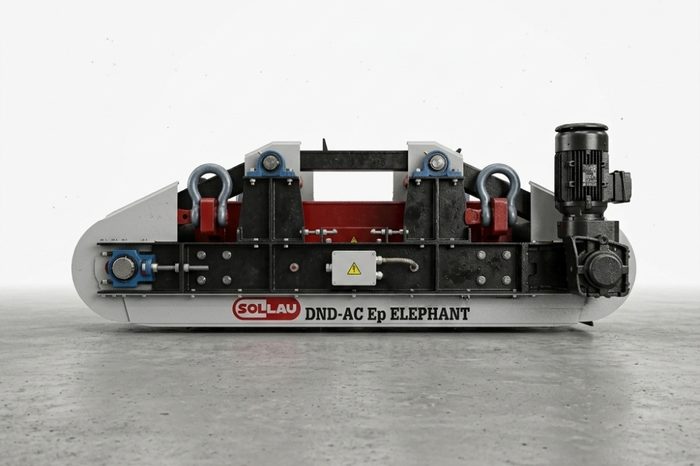
Suspended electromagnetic overband separator DND-AC-E above a conveyor belt
Deep layer, adjustable field

Suspended electromagnetic overband separator DND-AC-E

The only ones who supply a gauss chart and a reference-standard test report with every unit made.

Twelve types across four power ranges with an installation height of 300 to 600 mm, the full table is public on our website. The field can be regulated or switched off — during maintenance that means safe work under the magnet.

Details on DND-AC-E →
Enclosed magnetic drum MBZ in a housed construction
Dust-free separation unit

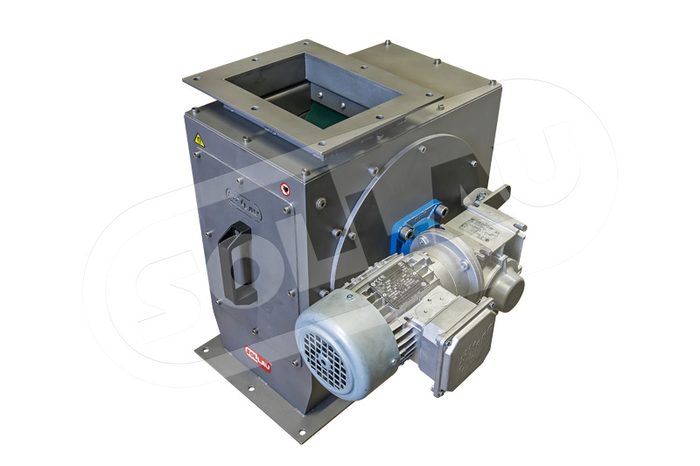
Enclosed magnetic drum MBZ

148 catalogue variants (74 GRIZZLY and 74 EKO) — the widest standard range of housed drums in Europe.

A drum in its own housing with an inlet hopper and outlets, capacity 20–285 m³/h, 5-year warranty. We'll loan you the base size, Ø304 × 500 mm, for your operation so you see the yield on your own material, not a sample.

Details on MBZ →
Automatic sorting line for municipal waste, plastic and paper
The whole line from one supplier

Or the whole separation line at once

An even layer ahead of the drum and ahead of the ECS decides the recovery rate — a customer who assembles a line from three suppliers usually doesn't manage that link.

Vibrating spreader feeder → magnetic plate or electromagnet → magnetic drum → non-ferrous metal separator → metal detector. We design, supply and commission the whole line, with separators from our own manufacturing in the Czech Republic (EU).

Recycling and waste processing industry →

Measured, not promised

Magnetic separator offers are hard to compare. Most manufacturers quote gauss values at the magnet surface — but the material on the belt sits 300 or 500 millimetres further away, where the field is already completely different. None of the twelve suspended-magnet manufacturers we compared publish their measurement methodology.

We do, and that's the main reason you're reading this page:

  • Gauss charts 0–400 mm, every 50 mm — you see the field curve, not a single number.
  • Test against 13 reference standards — nuts, wires, nails, balls. We measure the height from which the separator captures each one.
  • Measurement report with every unit made — proof on delivery, not a promise at signing.
  • Free test of your material within 3 days — on what you actually process.
Don't compare gauss values at the magnet surface.
Compare the field at the real installation height.

How we prove it

The numbers below come from our own installations and product specifications. We don't quote other companies' results or general estimates.

66 tsellable iron in a thousand-tonne daily sorting-plant capacity
2,000 kgCO₂ emissions saved for every tonne of metal recovered from bottom ash
320 mmcapture depth on a 2,000 mm belt — municipal waste line, 1,800 kg/h
99.7%separation efficiency of aluminium foil from PET flakes (ECS-E 500 BULL)

Municipal waste

A line with a DND-AC Ms4 EKO plate, an ECS separator and a magnetic roller: capacity up to 1,800 kg/h, metal separation from a size of 50 × 10 × 1 mm at a depth of up to 320 mm on a belt 2,000 mm wide.

RDF/SRF

An RDF/SRF producer, an Mx8 BEAST plate on a 1,400 mm belt with a 300 mm layer — a ferrite magnet where others use an electromagnet with continuous power draw.

Aluminium from mixed waste

A vibrating feeder and ECS separator setup: full capture of aluminium-coated packaging, and a payback the customer described as "a matter of a few weeks."

Wood chips

Magnetic drum MB 204 F 600: metal contaminants captured on the first pass; a check second pass caught no further nails.

Risk-free offer

An investment in a separator is a ten-year decision. Here are four ways to verify it before you make it.

Free material test within 3 days

Send a sample, we'll try a separator on it and give you a report with the result. No obligation.

Applies to DND-AC, MB, ECS, MBZ, mobile DND-AC, MV, EMG-SM and the vibrating spreader feeder.

Loan unit for your operation

If a sample isn't enough, we'll loan you a machine for your operation. In a month you'll see, on your own tonnes, how much metal you've been losing.

Applies to DND-AC (Ms3 F JAGUAR, NKS 1 JACKAL II), MB (304 N 500), MBZ (304 F 500, 304 N 500 and 204 F 300 GRIZZLY), mobile DND-AC (1,000 mm belt) and EMG-SM (Ø850 and 1,050 mm).

Base model in stock

Lead times in this industry tend to run eight weeks or more. We keep the base model in stock and ship it right away.

Applies to DND-AC (Ms3 F JAGUAR, NKS 1 JACKAL II), MB (304 N 500), ECS, MBZ (304 F 500, 304 N 500 and 204 F 300 GRIZZLY), mobile DND-AC and EMG-SM 085 and 105.

Free on-site consultation

Not sure where a separator belongs in your line? We'll come and take a look and tell you what makes sense — even if that's "nothing, for now."

Applies to the whole portfolio.

Current offer

Introductory price on the EMG-SM circular scrap electromagnet: 10% off, valid until 31 March 2027. For the EMG 115 SM size that means €10,917 instead of €12,130. An electromagnet for handling material up to 650°C with a 75% duty cycle for continuous operation.

Promotional discount on self-cleaning overband magnetic separators DND-AC: 7% off, valid until 9 December 2026. Applies to the whole range. Free test of your material with a result within three working days, measurement report with every unit made.

I want this offer

Frequently asked questions about the test

How does the test work and what do you need for it?

Tell us what you process, your capacity and belt width, and send us a material sample. We'll try a suitable separator on it, measure what it pulls out of the material, and send you a report with the result. You'll have the result within three working days, and it costs you nothing.

How much material should I send?

On the order of a few kilograms — a representative sample of what actually runs through your line, including contaminants. The more faithful the sample, the more accurate the result. For fine fractions such as bottom ash under 20 mm, we'll agree on the quantity based on the fraction.

How do I know a separator will pay off for me?

Two ways. First, revenue: iron makes up around 6.6% of municipal waste by weight, so in a thousand-tonne daily capacity that's roughly 66 tonnes of sellable iron. Second, equipment protection: one piece of fitting in the shredder means downtime, and at large operations that cost runs into thousands of euros. After the test we'll tell you how much metal can realistically be recovered from your material; you then work out the economics using your own buyback prices.

We run an incineration plant — which separator for bottom ash?

A magnetic drum or plate for iron, an ECS separator for non-ferrous metals. What matters is the rotor: around 80% of the non-ferrous metals in bottom ash are under 20 mm, and a concentric four-pole rotor only separates from 50 mm up. For bottom ash we therefore recommend the eccentric ECS-E BULL or BUFFALO models, which go down to 1 mm and 0.5 mm respectively. We'd treat any four-pole-machine offer for bottom ash, from anyone, with a healthy dose of scepticism.

We have a small line. Aren't your separators oversized?

No. Magnetic drums MB start at a diameter of 154 mm and are built specifically for post-sorting lines and smaller RDF/SRF producers — the big brands only start at a 300 mm diameter. With enclosed drums MBZ you choose from 148 catalogue variants, so the size fits without custom engineering.

How long does delivery take, and what if something breaks?

Lead time is 7–8 weeks, 8 weeks or more for ECS separators; base models are in stock and ship right away. We give a 10-year warranty on the magnetic core for DND-AC plates and 5 years for MB and MBZ drums; ECS-E BULL and BUFFALO separators come with 3 years including three service inspections. We guarantee a service response within two working days, next working day for ECS.

Send a sample. In three days you'll know where you stand.

Tell us what you process and your capacity. We'll get back to you within 24 hours and arrange a test — free and with no obligation.

Schedule a free test
David CablaSales Representative
+420 778 001 235
david.cabla@sollau.cz
Jakub EzechýlSales Representative
+420 775 877 833
jakub.ezechyl@sollau.cz
SOLLAU s.r.o.Czech manufacturer of magnetic separators
www.sollau.com
Top